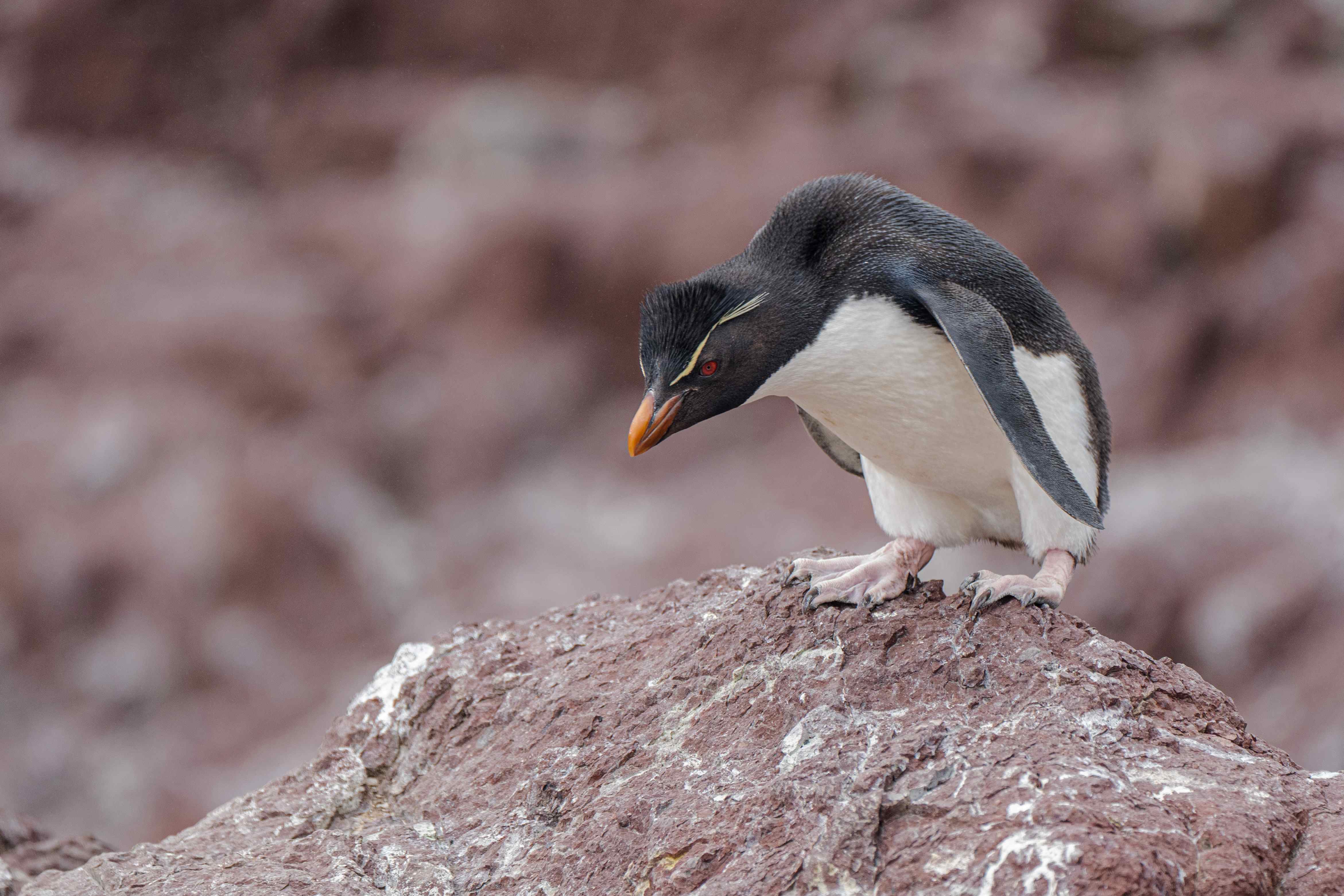
 Rockhopper penguin. Credit: Mailén Palma.
Penguins are birds adapted to marine life that are widely distributed throughout the Southern Hemisphere, where they play a key role in the functioning of the oceans. There are several species in the Argentine Sea, and each one uses its waters and coastlines in a different way. At WCS Argentina, we develepod conservation strategies with three of them.
The Magellanic penguin (Spheniscus magellanicus) is an iconic seabird of Patagonia with a wide coastal and oceanic range. It spends most of the year at sea, except between October and February, when it nests along the coast. In Argentina, it breeds in colonies from Río Negro province to Tierra del Fuego province. The largest colonies are found in the province of Chubut, with more than 640,000 breeding pairs, where the population has grown by 19.7% over the past two decades. In Santa Cruz and Tierra del Fuego, approximately 350,000 and 5,000 breeding pairs, respectively, breed, and in the Malvinas Islands, there are more than 90 identified colonies. This species is an apex predator in the southwestern Atlantic Ocean that can undertake foraging trips of thousands of kilometers, exposing itself to all human activities taking place at sea. According to the criteria of the International Union for Conservation of Nature (IUCN), in Argentina it is classified as Near Threatened, and globally, as Least Concern.
The Rockhopper penguin (Eudyptes chrysocome) is a very charismatic seabird distinguished by the yellow plumage on its head, its red eyes, its orange beak, and the way it hops among the rocks. Every year, it spends a season on the Argentine coast to nest and breed; the rest of the time, it migrates across the ocean in search of food. It is an excellent swimmer and feeds crustaceans, squid, and small fish. In Argentina, it is estimated that there are nearly 500,000 breeding pairs of this species. The colonies are found in the Isla Pingüino Interjurisdictional Marine Park (Santa Cruz Province), in the Isla de los Estados and Año Nuevo Archipelago Provincial Reserve (Tierra del Fuego and South Atlantic Islands Province) -with more than 160,000 nests according to the most recent monitoring- and in the Malvinas Islands and sub-Antarctic islands. According to IUCN criteria, it is listed as Endangered in Argentina and has been categorized as Vulnerable global.
The Gentoo penguin (Pygoscelis papua) is a species of penguin that has a permanent presence in the Beagle Channel, Tierra del Fuego. Historically, colonies were established in the Malvinas Islands, and in the early 1990s, a small colony was recorded on Martillo Island, which has since experienced significant growth, exceeding 60 breeding pairs in recent seasons. The year-round presence of this colony in the area, combined with its benthic feeding habits, makes this species a key indicator for monitoring the health of the marine environment in the Beagle Channel. According to IUCN criteria, in Argentina it is classified as a “Least Concern” species, and globally, as “Least Concern”.
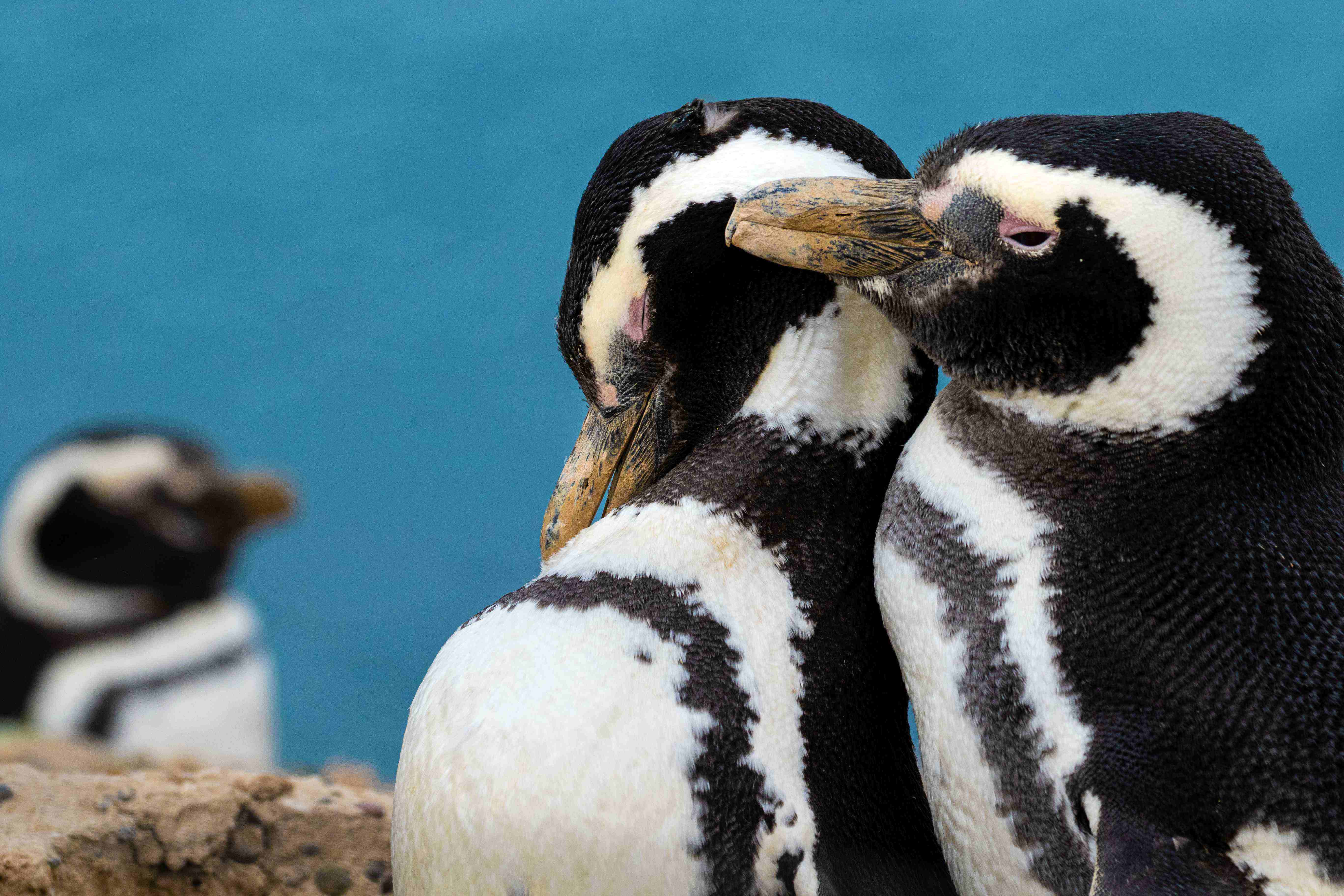 Pingüino de Magallanes. Crédito: Rodrigo Folch.
Challenges
Throughout their life cycle, these seabirds cross borders. For this reason, marine conservation in general -and the conservation of these penguins in particular- requires coordination at the regional level, sustained monitoring, and an adaptive approach.
Because they are highly sensitive to environmental changes, penguins are considered sentinels of the ocean’s health. Studying them provides insight into the status of the species itself, and their behavioral changes serve as indicators of shifts in the marine ecosystem.
The main threats to the Magellanic penguin are the impacts of climate change, overfishing, disturbances caused by irresponsible tourism, and pollution. Like most species, the Magellanic penguin is highly sensitive to food availability. In recent years, there has been a redistribution of the species within its colonies in Argentina, possibly because of the redistribution of its main prey species on the Argentine continental shelf.
The Rockhopper penguin is a species highly vulnerable to climate change. Various scientific studies have shown that, in recent decades, its foraging routes and food availability have been affected by changes in ocean currents caused by temperature fluctuations. Furthermore, these penguins are highly dependent on day length to synchronize their annual life cycle, and extreme high air temperatures lead to high chick mortality. Another threat comes from introduced herbivores that destroy tussock grasslands, key coastal habitats for nesting at some sites within their breeding range.
Our work
We work alongside researchers from CONICET and other scientific institutes dedicated to the study of these species, many of whom carry out their research projects with funding from WCS Argentina.
Since the 1980s, we have collaborated on monitoring penguin populations and studying their behavior in their breeding areas in Patagonia, using GLS and GPS devices, cameras, and other techniques. We collect demographic data such as breeding success and population trends, their feeding habits at sea, their spatial use of coastal-marine habitats, and the identification of new threats throughout their entire range.
We also work with provincial and national government agencies to promote the creation and management of Marine and Coastal Protected Areas (MPA) that safeguard the habitats where penguins carry out different stages of their life cycles, such as feeding and breeding. We have contributed to the creation of MPA, such as the Punta Tombo Provincial Reserve in 1972 and the Southern Patagonia Interjurisdictional Coastal Marine Park in 2009 (Chubut), as well as to the implementation of their management plans, such as those for the Deseado Estuary and the Makenke Interjurisdictional Marine Park (Santa Cruz), the Isla de los Estados Provincial Reserve, and the Atlantic Coast Nature Reserve (Tierra del Fuego). In addition, we work with integrated land management practices that improve the protection of colonies on private lands.
We have developed recommendations for tourism in protected areas such as the Valdés Peninsula and others, based on studies showing that human impact is minimal as long as visitors stay on designated trails -especially elevated ones- and avoid visiting during the hours around dawn and sunset.